


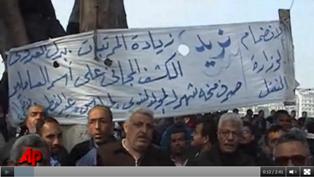
 DUBAI, United Arab Emirates (AP) -- The possible heirs of Egypt's uprising took to the streets Monday in different corners of the Middle East: Iran's beleaguered opposition stormed back to central Tehran and came under a tear gas attack by police. Demonstrators faced rubber bullets and birdshot to demand more freedoms in the relative wealth of Bahrain. And protesters pressed for the ouster of the ruler in poverty-drained Yemen.
The Skanner News Video here
The protests - all with critical interests for Washington - offer an important lesson about how groups across Middle East are absorbing the message from Cairo and tailoring it to their own aspirations.
The heady themes of democracy, justice and empowerment remain intact as the protest wave works it way through the Arab world and beyond. What changes, however, are the objectives. The Egypt effect, it seems, is elastic.
"This isn't a one-size-fits-all thing," said Mustafa Alani, a regional analyst at the Gulf Research Center in Dubai. "Each place will interpret the fallout from Egypt in their own way and in their own context."
For the Iranian opposition - not seen on the streets in more than a year - it's become a moment to reassert its presence after facing relentless pressures.
Tens of thousands of protesters clashed with security forces along some of Tehran's main boulevards, which were shrouded in clouds of tear gas in scenes that recalled the chaos after the disputed re-election of President Mahmoud Ahmadinejad in June 2009.
"Death to the dictator," many yelled in reference to Ahmadinejad. Others took aim Iran's all-powerful Supreme Leader Ayatollah Ali Khamenei with chants linking him with toppled rulers Hosni Mubarak in Egypt and Tunisia's Zine Al Abidine Ben Ali.
"Bin Ali, Mubarak, it's Seyed Ali's turn," protesters cried.
The reformist website kaleme.com said police stationed several cars in front of the home of opposition leader Mir Hossein Mousavi ahead of the demonstration. Mousavi and fellow opposition leader Mahdi Karroubi have been under house arrest since last week after they asked the government for permission to hold a rally in support of Egypt's uprising - which Iran's leaders have claimed was a modern-day replay of their 1979 Islamic Revolution.
Kd Mousavi, however, have compared the unrest in Egypt and Tunisia with their own struggles. Mousavi said all region's revolts aimed at ending the "oppression of the rulers."
A new U.S. State Department Twitter account in Farsi took a jab at Iran in one of its first messages Sunday, calling on Tehran to "allow people to enjoy same universal rights to peacefully assemble, demonstrate as in Cairo."
U.S. Secretary of State Hillary Rodham Clinton expressed support for the Iranian protesters, saying theyto have the same rights that they saw being played out in Egypt and are part of their own birthright."
In Yemen, meanwhile, the protests are about speeding the ouster of the U.S.-allied president, Ali Abdullah Saleh, who has promised he would step down in 2013.
Monday'sirrored the calls in Egypt and Tunisia against their own leaders who had been in power for decades: "The people want the regime to step down."
Protesters in the tiny Gulf nation of Bahrain are not looking to topple its monarchy. But their demands are no less lofty: greater political freedom and sweeping changes in how the country is run.
The next possible round of demonstrations gives a similar divide.
A coalition in Algeria - human rights activists, unionists, lawyers and others - has called protests Saturday to push for the end of President Abdelaziz Bouteflika's 12-year rule. Kuwait's highly organized opposition, including parliament members, plans gatherings March 8 to demand a wholesale change of cabinet officials, but not the ruling emir.
"We are experiencing a pan-Arab democratic moment of sorts," said Shadi Hamid, director of research at The Brookings Doha Center in Qatar. "For opposition groups, it comes down the question of, `If not now, when?'"
But he noted that the newfound Arab confidence for change will go in various directions.
"The Arab opposition are using the Egyptian model as a message that anything is possible," Hamid said. "Then they interpret that into their local context."
In Yemen, more than 1,000 people, including lawyers in their black courtroom robes, joined a fourth consecutive day of protests in the capital of Sanaa - a day after police attacked anti-government marchers with sticks and daggers. Human Rights Watch said police on Sunday also used stun guns and batons to disperse protesters.
"We will continue our protests until the regime falls," independent lawmaker Ahmed Hashid said.
Police separated the opposition rally from a dozen government supporters holding pictures of the president.
Bahrain was more violent. Security forces fired tear gas, rubber bullets and birdshot pellets at thousands of anti-government protesters heeding calls to unite in a major rally and bring the Arab reform wave to the Gulf for the first time. At least 25 people were injured, and one man died after suffering severe head trauma.
Police later used vans and other vehicles to block main roads into the capital of Manama to prevent a mass gathering that organizers intended as an homage to Egypt's Tahrir Square.
Social media sites have been flooded with calls by an array of political youth groups, rights activists and others to join demonstrations Monday, a symbolic day in Bahrain as the anniversary of the country's 2002 constitution that brought pro-democracy reforms such as an elected parliament.
But opposition groups seek deeper changes from the country's ruling dynasty, including transferring more decision-making powers to the parliament and breaking the monarchy's grip on senior government posts. Bahrain's majority Shiites - about 70 percent of the population - have long complained of systemic discrimination by the Sunni rulers.
The nation - no bigger in area than New York City - is among the most politically volatile in the Gulf. A crackdown on perceived dissidents last year touched off riots and street battles in Shiite areas.
Some protesters carried mock Valentine's Day greetings from a prominent Bahraini blogger in custody, Ali Abdul-Imam.
"Arabs have been inspired by Egypt and empowered to believe that their voices must be heard and respected," wrote James Zogby, president of the Arab American Institute, in a commentary in Abu Dhabi's The National newspaper. "It will make life more complicated for Western and Arab policy makers."
Monday's unrest touched on two key points of Washington's Mideast constellation.
Bahrain is home to the U.S. Navy's 5th Fleet, one of the Pentagon's main counterweights to Iran's attempts to expand influence in the Gulf. Yemen's militant networks offer safe haven for al-Qaida in the Arabian Peninsula, which has planned and launched several attack against the U.S., including the attempted airliner bombing on Christmas Day 2009 and the failed mail bomb plot involving cargo planes last summer.
The U.S. military plans a $75 million training program with Yemen's counterterrorism unit to expand its size and capabilities in the nation's difficult mountain terrain. Last month, the U.S. also delivered four Huey helicopters to Yemen and has been training the aviation units.
"What has happened in Tunisia and Egypt has terrified pro-Western Arab rulers," said Fawaz Gerges, a professor of Middle Eastern politics at the London School of Economics.
"One of the lessons that the U.S. will take from current unrest is that the status quo is no longer sustainable," he added. "There are huge cracks in the Arab authoritarian wall. It's the end of an era and the U.S. must make very tough choices and decisions."
Turkish President Abdullah Gul, who is visiting Iran, urged governments in the Middle East to listen to the their people.
"When leaders and heads of countries do not pay attention to the demands of their nations, the people themselves take action to achieve their demands," the official Islamic Republic News Agency quoted Gul as saying.
---
Associated Press writer Dale Gavlak in Amman, Jordan, contributed to this report.
Portland and Seattle
Free Subscription to Breaking News
Free Subscription to Breaking News


